Rethinking Accounts Receivable with AI: From 4 Hours to Minutes
Most finance teams are not short on data. They have ERP systems, CRMs, aging reports, and spreadsheets going back years. What they are often short on is time and by the time a clear picture of cash flow finally comes together each morning, the day has already moved on.
This is the quiet inefficiency at the heart of accounting operations today. It is not technology gap. The systems are there. It is a workflow problem, one that AI agents are beginning to solve in surprisingly practical ways.
Where the inefficiency shows up
Accounts receivable and accounts payable sit on opposite ends of the same cash flow equation, money coming in and money going out. Both are operationally critical. Both tend to suffer from the same root problem: too much time spent building a picture of the situation before any real decision-making can begin.
| Accounts Receivable Who owes you, and when? Morning AR routines, pulling aging reports, chasing regional updates, reconciling overdue accounts can consume 3–4 hours before a single collection call is made. The result is a backward-looking snapshot, not a forward-looking guide. | Accounts Payable What do you owe, and to whom? AP teams manually match invoices, track approval chains, and flag duplicates. Early payment discounts get missed. Penalty exposure builds quietly. Decisions about what to pay and when are rarely as informed as they could be. |
What does an AI agent do differently?
Traditional dashboards are designed for storage and reporting, they answer the question: what happened? AI agents are designed for the question that matters more operationally: what should I do next?
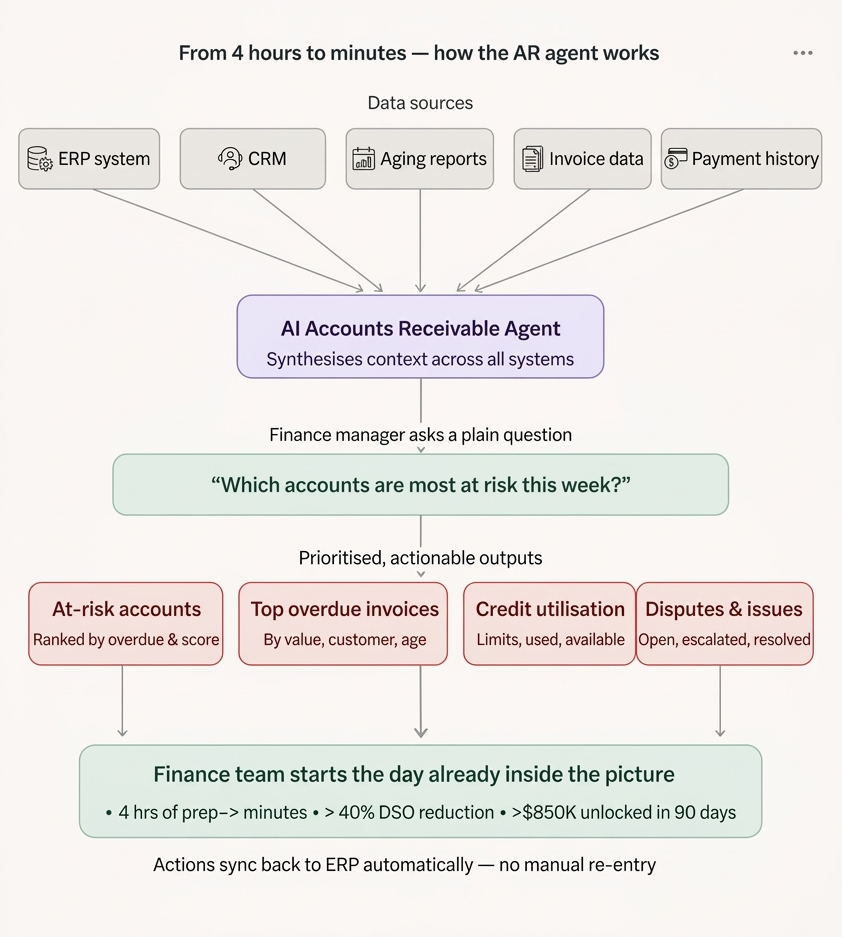
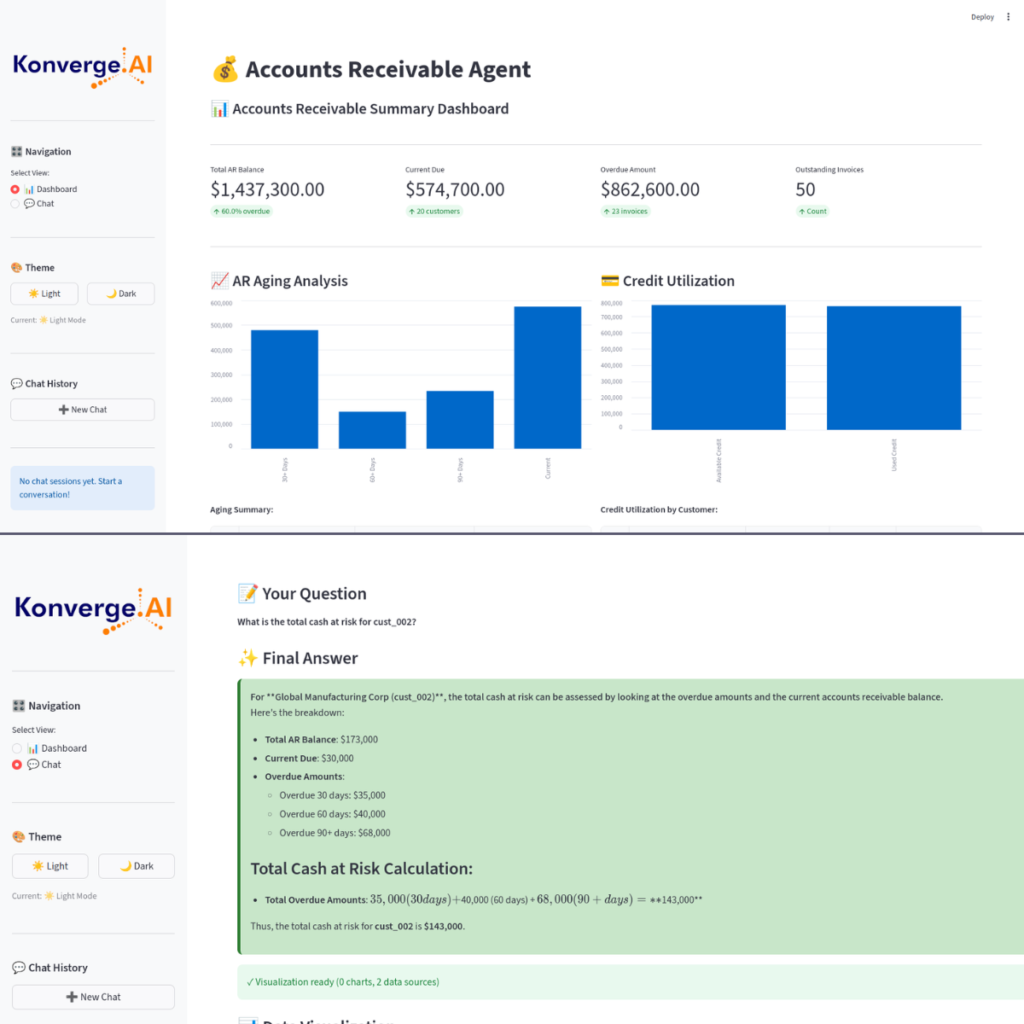
Rather than logging into four systems and building a pivot table, a finance manager can ask plainly: “Which accounts are most at risk of delaying payment this week?” or “Are there any AP invoices approaching penalty deadlines?” The agent connects invoice data, payment history, credit limits, approval status, and open disputes and surfaces a prioritized list, not a raw export.
This is not magic. It is synthesis. Agents close the gap between data that exists and decisions that need to happen.
A case that illustrates the shift
A mid-sized logistics company managing receivables across multiple regions introduced an AI-powered AR agent after their finance team flagged how much time was consumed just getting to a daily snapshot. Collections were inconsistent, driven more by urgency than impact, with high-value overdue accounts occasionally missed while smaller ones received disproportionate attention.
- 3–4 hrs daily AR prep cut to minutes
- $850K in receivables unlocked in 90 days
- 40% reduction in days sales outstanding
Within 90 days, the numbers shifted significantly. But the more durable change was operational: the team stopped starting their day by building a picture of the situation and started their day already inside one.
The broader direction
What is emerging in AR is an early signal of something larger. The same pattern agents that synthesize context across systems and surface prioritized actions, applies equally to AP, treasury, and financial risk. Predictive models that flag accounts before they become overdue. Automated outreach for routine follow-ups. AP workflows that surface early payment opportunities and flag duplicate invoices before they clear. Actions that sync directly back into ERP systems without manual entry.
Over time, this points toward something closer to a financial co-pilot: a system that monitors the full picture continuously and surfaces what needs attention before it becomes a problem. Not replacing the judgment of the finance team, but removing the hours of groundwork that currently precede it.
What this means in practice
The clearest immediate benefit is not automation for its own sake, it is that complex analysis stops being the exclusive domain of technical users. When a regional manager can ask a plain question and get a meaningful answer, the gap between data and decision shrinks for everyone, not just those fluent in spreadsheets.
Cash flow timing defines business agility in ways that are easy to underestimate until it becomes urgent. Getting decisions made faster, with better information, earlier in the day, that is the practical value on offer. And for most finance teams, it is already within reach.
AI agents are not a replacement for finance expertise. They are what happens when that expertise no longer has to spend its morning pulling reports.
We’ve built a working demo that brings this to life. If you’d like to see how this could work in your organization – book a meeting with us
- Rethinking Accounts Receivable with AI: From 4 Hours to Minutes

- The AI-Native SDLC: Intelligent Engineering for Speed and Scale

- India’s Union Budget 2026 Surfaces Four Strategic Advantages for Global AI Leaders

- Agentic Workflows: Turning Enterprise Intent into Governed Execution

- 5 Things to Get Right Before Building Data Pipelines for Agentic AI

- Why Metadata-Driven Data Engineering Matters for Enterprise AI

- The AI-First GCC Model Redefining Enterprise Innovation in 2026

- Konverge AI Partners with NextWave to Set Up its Global Capability Center (GCC) in India
- Konverge AI Strengthens Ties with Microsoft, Listing DataLens on Azure Marketplace

- Konverge AI Moves from Challenger to Seasoned Vendor in AIM PeMa Quadrant for GenAI Services 2024

- Konverge AI Achieves ISO 27001, Strengthens Enterprise Data Security

- Konverge AI Join Forces with Dataiku to Accelerate and Scale AI Across Enterprises