Agentic Workflows: Turning Enterprise Intent into Governed Execution
Enterprise operations today are rich in tools but constrained by coordination. Tickets capture requests, teams interpret them, systems execute them, and governance is often applied after execution. As environments scale, this gap between intent and execution becomes a source of delay, inconsistency, and operational risk.
This is where agentic workflows are beginning to reshape how work gets done.
Agentic workflows decompose complex operational processes into a set of specialized, goal-oriented agents. Each agent is responsible for a distinct function — interpreting intent, validating inputs, enforcing policy, coordinating approvals, or executing actions — while the overall workflow remains governed, auditable, and human-supervised.
Rather than automating isolated tasks, agentic systems focus on orchestrating decisions.
From Tickets to Executable Intent
In most enterprises, tickets are the starting point of operational work. They serve as systems of record, prioritization, and accountability. However, they typically stop at documentation. Humans are required to interpret the request, translate it into implementation steps, and coordinate execution across tools and teams.
Agentic workflows enable a different model, one where tickets can act as structured expressions of intent that systems can reason over and execute responsibly.
As part of my exploration into this approach, I recently built a proof of concept to assess how far intent-driven operations can be applied in a real enterprise context.
The objective was to evaluate whether cloud infrastructure setup could be automated using only a Jira ticket as the input, without Ops team manually provisioning resources. The workflow treats the ticket itself as an executable intent.
Example: Automating Ops – From Jira Straight to AWS
The prototype was built using Google’s Antigravity (agentic IDE) to orchestrate a team of AI agents, each responsible for a specific stage of the workflow.
A user creates a Jira ticket, for example, a “Create S3 bucket” with relevant details in the description. The system then:
- Reads and interprets the request
- Generates Terraform code automatically
- Validates the configuration against security and policy requirements
- Pauses for explicit human approval before deployment
Once provisioning is complete, the Jira ticket is updated automatically with deployment status and details.
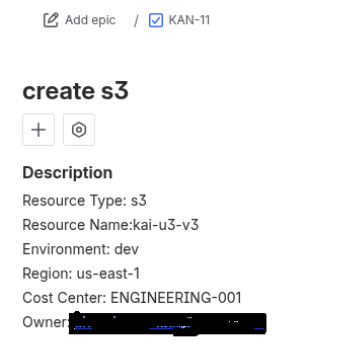
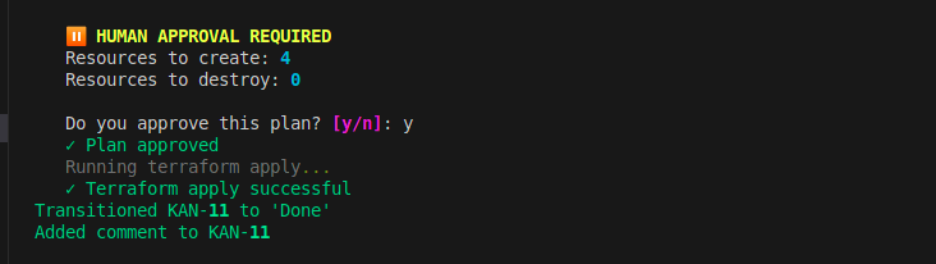
The solution is implemented as a multi-agent workflow, orchestrated using LangGraph, with clearly defined responsibilities:
- Validation Agent – Ensures ticket completeness and correctness
- Coding Agent – Generates Terraform configuration
- Security Agent – Enforces safety and policy guardrails
- Human Gate – Requests manual approval
- Deployment Agent – Provisions resources in AWS and updates Jira
The prototype is currently scoped to S3 bucket provisioning. Resources are deployed with encryption, versioning, and standardized tagging enforced by default, demonstrating how governance can be embedded directly into execution.
The intent of this example is not the specific AWS resource, but the agentic workflow pattern itself.
Why Agentic Workflows Matter
The value of agentic workflows extends beyond speed or efficiency. Their real impact lies in consistency, governance, and scalability:
- Policies are enforced by design, not by exception
- Human oversight is embedded at decision points
- Execution becomes repeatable and auditable
- Operational complexity is absorbed by systems, not teams
This enables organizations to scale operations without proportionally increasing risk or cognitive load.
Agentic workflows represent a shift from automation as execution to automation as decision orchestration. As enterprises adopt AI across platforms and processes, this model offers a practical way to translate intent into outcomes while preserving trust, control, and accountability.
Enterprise operations are shifting from tool-centric models to intent-driven, governed execution.
- Rethinking Accounts Receivable with AI: From 4 Hours to Minutes

- The AI-Native SDLC: Intelligent Engineering for Speed and Scale

- India’s Union Budget 2026 Surfaces Four Strategic Advantages for Global AI Leaders

- Agentic Workflows: Turning Enterprise Intent into Governed Execution

- 5 Things to Get Right Before Building Data Pipelines for Agentic AI

- Why Metadata-Driven Data Engineering Matters for Enterprise AI

- The AI-First GCC Model Redefining Enterprise Innovation in 2026

- Konverge AI Partners with NextWave to Set Up its Global Capability Center (GCC) in India
- Konverge AI Strengthens Ties with Microsoft, Listing DataLens on Azure Marketplace
- Konverge AI Moves from Challenger to Seasoned Vendor in AIM PeMa Quadrant for GenAI Services 2024

- Konverge AI Achieves ISO 27001, Strengthens Enterprise Data Security

- Konverge AI Join Forces with Dataiku to Accelerate and Scale AI Across Enterprises